Weight Loss + Smoothies
25 Smoothies for Weight Loss That Actually Keep You Full
No chalky protein paste, no “detox” theater — just honest, blendable recipes your body and your taste buds will both thank you for.
Image Prompt for Designers / AI Art Tools
Overhead flat-lay of five colorful weight-loss smoothies in clear glass jars arranged on a worn linen cloth, surrounded by fresh spinach leaves, halved strawberries, blueberries, a sliced banana, and a small bowl of chia seeds. Soft warm morning light streams in from the upper-left corner. Rustic wooden cutting board partially visible at the edge. Muted sage, coral, and cream color palette. Styled for a clean food blog or Pinterest recipe pin — approachable, bright, and appetizing without being overly staged.
Let’s skip the preamble where I tell you smoothies changed my life. They didn’t, not on their own. What they did do was make one meal of the day dramatically less stressful, noticeably more filling, and weirdly enjoyable — even on mornings when the last thing I wanted was to stand in a kitchen. If you’ve been frustrated by weight loss smoothies that taste like blended lawn clippings or leave you hungry forty minutes later, this list is for you.
The 25 smoothies for weight loss here are built around a simple idea: high fiber, solid protein, and ingredients that do actual work in your body. No magic powders, no expensive imports, and absolutely no pretending that a cup of mango juice with half a banana constitutes a meal. These are real recipes, most of which you can pull together in under five minutes with a decent blender and a mostly-stocked fridge.
We’ll cover the science briefly (because it actually matters), then get straight into the recipes with everything you need — ingredients, the why behind them, and a note on what makes each one particularly effective for weight management. Ready? Let’s blend.
Why Smoothies Actually Work for Weight Loss (When Done Right)
Before we get to the recipes, a quick reality check. A smoothie is not inherently a weight-loss tool. Pour in a cup of orange juice, two bananas, agave syrup, and a handful of granola, and you’ve got a 600-calorie sugar bomb that’ll have you raiding the pantry by 10 AM. The difference between a smoothie that works and one that doesn’t comes down to a few non-negotiable ingredients.
Protein is the big one. According to nutrition guidance from Johns Hopkins Medicine, protein builds and maintains muscle mass while helping you feel full and satisfied — both critical factors in any sustained weight loss effort. Aim for at least 20–25g per smoothie if it’s replacing a meal.
Fiber is the close second. Chia seeds, flaxseed, oats, leafy greens — these slow down digestion and keep blood sugar from spiking and crashing in the hour after you drink. Research on nutrient-dense, low-calorie foods consistently shows that people who prioritize fiber-rich ingredients achieve better weight loss outcomes than those who rely on calorie restriction alone. You can read more on that via WebMD’s breakdown on smoothie nutrition.
Liquid base matters more than most people realize. Unsweetened almond milk, coconut water, or plain water are your friends here. Fruit juice is not. Even 100% orange juice adds 110 calories and almost no fiber to your smoothie before you’ve put a single real ingredient in.
Pro Tip
Build every weight-loss smoothie using the 3-2-1 rule: 3 parts vegetables or low-sugar fruit, 2 parts protein source (Greek yogurt, protein powder, silken tofu), 1 part healthy fat (nut butter, chia seeds, avocado). This ratio keeps calories controlled, hunger satisfied, and blood sugar stable.
One more thing worth saying: smoothies work best as part of a wider eating strategy, not as the entire strategy. If you want a full roadmap that puts these smoothies into proper context, the 7-day flat belly meal plan on this site is a great place to pair them — it gives you the scaffolding around which your morning smoothie can actually do its job.
The 25 Best Smoothies for Weight Loss
These are organized loosely by goal and ingredient profile — green/vegetable-forward, high-protein, berry-based, tropical/low-sugar, and a few that fall into the “dessert you can justify” category. All of them are under 400 calories when made to the listed portions, and all include enough protein and fiber to function as a genuine meal replacement.
Green Smoothies for Weight Loss
Don’t roll your eyes. These aren’t punishing. The trick is balancing leafy greens with enough fruit sweetness and creamy protein to make the whole thing taste like something you’d actually choose to drink.
Spinach Banana Almond Butter Smoothie
The classic entry-level green smoothie for a reason. Spinach disappears into the flavor profile completely — you taste banana and almond, that’s it.
- 2 cups baby spinach
- 1 frozen banana
- 2 tbsp almond butter
- 1 scoop vanilla protein powder
- 1 cup unsweetened almond milk
- Ice to blend
Kale, Cucumber, and Ginger Detox Smoothie
Cucumber adds serious volume for almost no calories, while ginger brings a gentle anti-inflammatory kick. This one’s particularly good if bloating is part of what you’re trying to tackle.
- 1 cup kale (stems removed)
- 1/2 cucumber, chopped
- 1 tsp fresh ginger, grated
- 1/2 green apple
- 1 tbsp chia seeds
- 1 cup coconut water
Green Tea Spinach Pineapple Boost
Chilled green tea as a smoothie base is one of those swaps that sounds odd until you try it. The catechins in green tea have a mild metabolism-supporting effect, and it adds zero calories.
- 1 cup chilled brewed green tea
- 1.5 cups baby spinach
- 1/2 cup frozen pineapple
- 1/4 avocado
- 1 tbsp ground flaxseed
- Juice of half a lemon
Hidden Zucchini Vanilla Smoothie
Frozen zucchini is genuinely one of the best smoothie hacks. It adds thickness, almost no flavor, and a solid dose of fiber and potassium — all while making your smoothie feel luxuriously creamy.
- 1 cup frozen zucchini chunks
- 1 scoop vanilla protein powder
- 1 cup unsweetened oat milk
- 1/2 tsp cinnamon
- 1 tbsp almond butter
- Handful of ice
Celery, Apple, and Lemon Cleanser
Celery is 95% water, which means it contributes bulk and hydration while barely registering on the calorie counter. Pair it with tart apple and lemon and it’s surprisingly bright and refreshing.
- 3 stalks celery
- 1 green apple, cored
- Juice of 1 lemon
- 1 tsp spirulina (optional)
- 1 cup water
- 1 tbsp chia seeds
Speaking of hiding vegetables where no one will find them — if you enjoy the idea of sneaking nutrition into something that genuinely tastes good, the 25 smoothies with hidden veggies collection is worth bookmarking. It’s the same philosophy, applied across a much wider flavor range.
High-Protein Smoothies for Weight Loss
These are the heavy hitters — the ones designed to genuinely replace a meal and not send you crawling toward the biscuit tin an hour later. FYI, the protein-to-calorie ratio is what separates these from your average fruit smoothie.
Greek Yogurt Berry Protein Shake
Greek yogurt over regular yogurt every time — it has nearly double the protein and a thicker texture that makes your smoothie feel like a proper meal. This one clocks in around 35g of protein.
- 1 cup plain Greek yogurt (full-fat)
- 1 cup frozen mixed berries
- 1 scoop unflavored whey protein
- 1 tbsp ground flaxseed
- 1/2 cup water or almond milk
Chocolate Peanut Butter Protein Smoothie
This one tastes like a Reese’s milkshake and I will not apologize for that. The peanut butter delivers healthy monounsaturated fats that extend satiety well past the two-hour mark.
- 1 scoop chocolate protein powder
- 2 tbsp natural peanut butter
- 1 cup unsweetened almond milk
- 1/2 frozen banana
- 1 tsp cacao powder
- Ice and a pinch of sea salt
Silken Tofu Mango Protein Smoothie
Silken tofu is the dairy-free smoothie upgrade you probably haven’t tried yet. It blends completely smooth, adds around 8–10g of plant protein per 100g, and disappears behind whatever fruit you pair it with.
- 150g silken tofu
- 1 cup frozen mango
- 1 tbsp chia seeds
- 1/2 tsp turmeric
- Juice of 1 lime
- 3/4 cup coconut water
Oat and Cottage Cheese Morning Smoothie
Cottage cheese in a smoothie is having its moment — and it deserves to. It blends beautifully, provides casein protein (slow-digesting, which means longer satiety), and adds a subtle creaminess.
- 1/2 cup low-fat cottage cheese
- 1/4 cup rolled oats
- 1/2 cup frozen blueberries
- 1 tsp honey
- 1 cup almond milk
- Ice
Hemp Seed Avocado Green Protein Smoothie
Hemp seeds are a complete protein source — meaning they contain all nine essential amino acids — which makes them a remarkably efficient addition to any plant-based smoothie. Three tablespoons gives you about 10g of protein.
- 3 tbsp hemp seeds
- 1/4 avocado
- 1 cup spinach
- 1/2 frozen banana
- 1 cup oat milk
- 1 tsp matcha powder
More High-Protein Inspiration
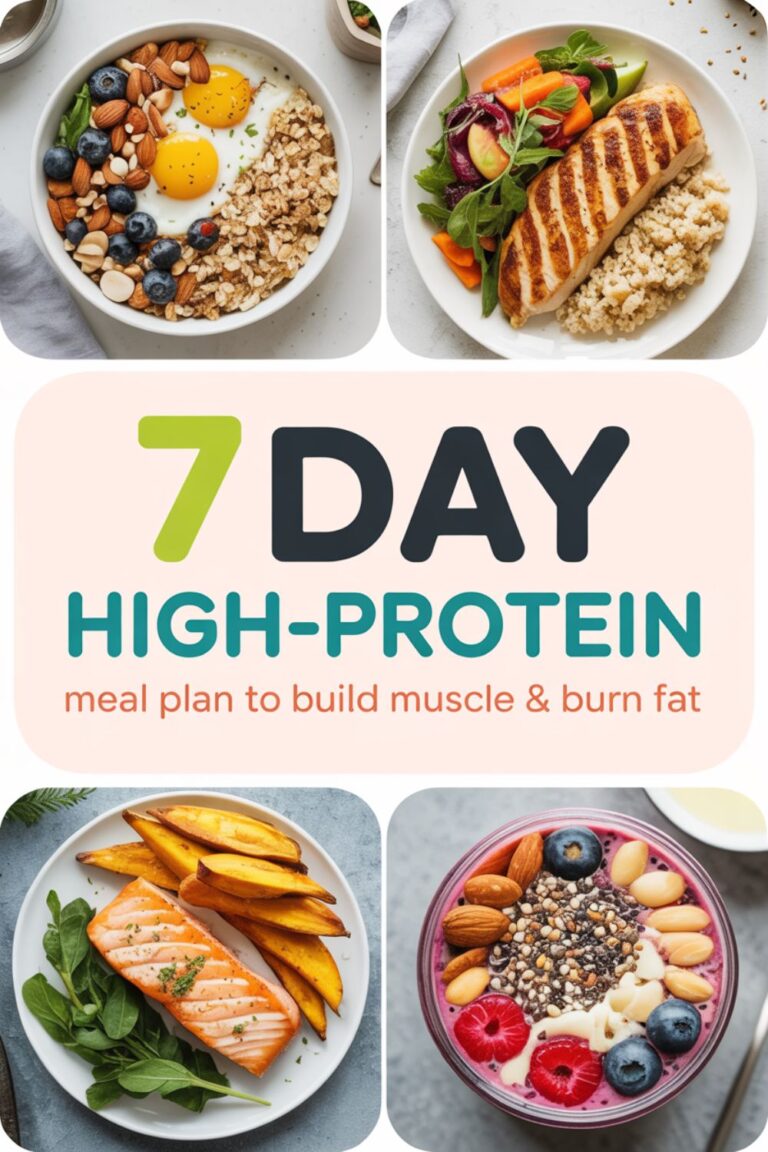
If these high-protein smoothies are hitting the right note, you’ll want to see the full 21 high-protein smoothies that taste like dessert collection — same approach, wider flavor range. And if you’re building this into a broader muscle-and-fat-loss strategy, the 7-day high-protein meal plan is genuinely worth a look.
Berry-Based Smoothies for Weight Loss
Berries are the weight-loss smoothie ingredient that earns its hype. They’re naturally low in sugar compared to tropical fruits, packed with antioxidants, and high in polyphenols that support both fat metabolism and gut health. Blueberries and strawberries, in particular, are consistently associated with reduced inflammatory markers.
Triple Berry Chia Smoothie
Chia seeds are the quiet achievers of the smoothie world. They absorb up to 10 times their weight in liquid, expanding in your stomach and extending fullness for a genuinely impressive amount of time.
- 1/2 cup frozen blueberries
- 1/2 cup frozen raspberries
- 1/2 cup frozen strawberries
- 2 tbsp chia seeds
- 1 cup unsweetened almond milk
- 1/2 scoop vanilla protein powder
Strawberry Beet Glow Smoothie
Beets are an underused smoothie ingredient and a shame about that, honestly. They’re rich in nitrates that support blood flow and exercise performance — useful if you’re pairing your smoothie habit with regular movement.
- 1 cup frozen strawberries
- 1 small cooked beet, cubed
- 1 tbsp flaxseed
- 1 cup plain Greek yogurt
- 1/2 cup water
- Juice of half an orange
Blueberry Oat Breakfast Smoothie
Adding oats to a smoothie is the move if you want it to function as a real breakfast rather than a snack. The beta-glucan fiber in oats is one of the most well-researched satiety-supporting compounds in the food world.
- 1 cup frozen blueberries
- 1/3 cup rolled oats
- 1 cup unsweetened almond milk
- 2 tbsp almond butter
- 1/2 tsp cinnamon
- 1 tsp honey (optional)
Blackberry Spinach Weight-Loss Shake
Blackberries have one of the highest fiber contents of any common smoothie fruit — about 7g per cup — which makes them a particularly smart choice when you want a berry that actually fills you up.
- 1 cup frozen blackberries
- 1.5 cups baby spinach
- 1 scoop unflavored protein powder
- 1 tbsp chia seeds
- 1 cup coconut water
- 1/2 tsp vanilla extract
Raspberry Lemon Yogurt Smoothie
The lemon here isn’t just for flavor — the citric acid slows the breakdown of fruit sugars slightly, smoothing out any blood sugar response. IMO this is one of the most refreshing smoothies in the entire list.
- 1 cup frozen raspberries
- Zest and juice of 1 lemon
- 3/4 cup plain Greek yogurt
- 1 tbsp ground flaxseed
- 1/2 cup water
- Ice
“I’d been trying different weight-loss approaches for about six months and nothing was sticking. I started making the triple berry chia smoothie every morning and replaced my usual bagel. Three months later I was down 14 pounds without feeling like I was on a diet at all.”
— Melissa R., community memberMeal Prep Essentials Used in This Plan
A friend-to-friend round-up of the things that actually make a smoothie habit sustainable long-term.
Physical Products
-
High-Speed Countertop Blender (Vitamix or equivalent) The single investment that makes or breaks a smoothie habit. A weak blender leaves leafy greens stringy and chia seeds whole — a strong one gives you velvet. I use mine daily and it’s paid for itself many times over in avoided coffee shop smoothies.
-
Quart-Size Reusable Freezer Bags (set of 20) Prep five smoothie packs on Sunday, freeze them flat, and your entire week’s breakfasts are sorted. These wide-mouth bags make filling and sealing clean and painless.
-
Wide-Mouth Insulated Smoothie Cup with Straw Lid For mornings when you need to take your smoothie with you. The insulation keeps it cold for three hours and the lid doesn’t leak — two features that matter more than they sound.
Digital Products
-
30-Day Flat Belly Meal Plan Pairs perfectly with this smoothie list — it gives you lunch and dinner scaffolding while your morning smoothie handles the first meal of the day.
-
7-Day Gut Health Reset Plan Several smoothies in this list (especially the ginger and kale ones) complement a gut reset beautifully. This plan fills in the rest of the day.
-
14-Day Low Sugar Meal Plan If blood sugar management is part of your weight-loss approach, this plan and the low-sugar smoothies in this article make a strong pairing.
Tropical and Low-Sugar Smoothies for Weight Loss
Here’s a note on tropical fruits: mango, pineapple, and papaya are higher in natural sugar than berries, but they’re not the enemy. The key is using them in controlled amounts, paired with fiber and protein to blunt any blood sugar response. The following smoothies use tropical flavors smartly — enough sweetness to make the smoothie enjoyable, not enough to undermine the goal.
Turmeric Mango Anti-Inflammatory Smoothie
Turmeric’s active compound, curcumin, has been studied extensively for its anti-inflammatory properties — and chronic low-grade inflammation is closely linked to weight gain and metabolic slowdown. This combination is both powerful and genuinely delicious.
- 3/4 cup frozen mango
- 1 tsp ground turmeric
- 1/2 tsp black pepper (activates curcumin)
- 1/2 cup plain Greek yogurt
- 1 cup coconut water
- 1 tbsp chia seeds
Papaya Lime Digestive Smoothie
Papaya contains an enzyme called papain that actively aids protein digestion — an underrated benefit for anyone consuming significant amounts of protein through smoothies and meals. It’s also very low in calories relative to its volume.
- 1 cup frozen papaya chunks
- Juice of 1 lime
- 1/2 cup plain Greek yogurt
- 1 tbsp ground flaxseed
- 3/4 cup water
- Fresh mint (optional)
Pineapple Spinach Coconut Smoothie
Pineapple contains bromelain, an enzyme with documented anti-inflammatory and digestive benefits. Used in moderation (half a cup max), it sweetens a smoothie beautifully without going overboard on the sugar front.
- 1/2 cup frozen pineapple
- 1.5 cups baby spinach
- 1/4 cup canned full-fat coconut milk
- 1 scoop vanilla protein powder
- 3/4 cup water
- Ice
Quick Win
Swap fruit juice for coconut water in any smoothie recipe. You cut roughly 90 calories and 20g of sugar per cup while still getting natural electrolytes and a subtle tropical sweetness. Small change, real difference over a week.
If you’re also working on reducing bloating alongside weight loss, you’ll find the 7-day anti-inflammatory meal plan pairs beautifully with the turmeric and ginger smoothies above — it builds on the same nutritional principles across every meal of the day.
Dessert-Style Smoothies That Still Support Weight Loss
Yes, these are real. The key is using nutrient-dense ingredients to replicate the flavors you crave without the added sugar and refined flour that usually come with them. These are ideal for late-afternoon cravings or evenings when you want something sweet that won’t derail the day.
Chocolate Cherry “Black Forest” Smoothie
Cherries are one of the few fruits with naturally occurring melatonin, making this an oddly good evening smoothie. The cacao powder adds genuine chocolate flavor with a fraction of the sugar of cocoa-based products.
- 1 cup frozen dark cherries
- 2 tbsp raw cacao powder
- 1 scoop chocolate protein powder
- 1 cup almond milk
- 1 tbsp almond butter
- Pinch of sea salt
Peanut Butter Banana “Nice Cream” Smoothie
Two frozen bananas blended alone create something that genuinely resembles soft-serve ice cream in texture. Add peanut butter and you have a dessert smoothie with a real macronutrient profile.
- 2 frozen bananas
- 2 tbsp natural peanut butter
- 1 tsp vanilla extract
- 1/2 cup almond milk
- 1 tbsp hemp seeds
Vanilla Cardamom Pear Smoothie
Pears are one of the most underused smoothie fruits. They’re high in fiber (one pear has about 5.5g), naturally sweet without being sugar-dense, and the cardamom here adds an almost chai-like warmth that makes this feel indulgent.
- 1 ripe pear, cored and frozen
- 1/4 tsp cardamom
- 1 tsp vanilla extract
- 3/4 cup plain Greek yogurt
- 1/2 cup almond milk
- 1 tbsp chia seeds
Related Reading
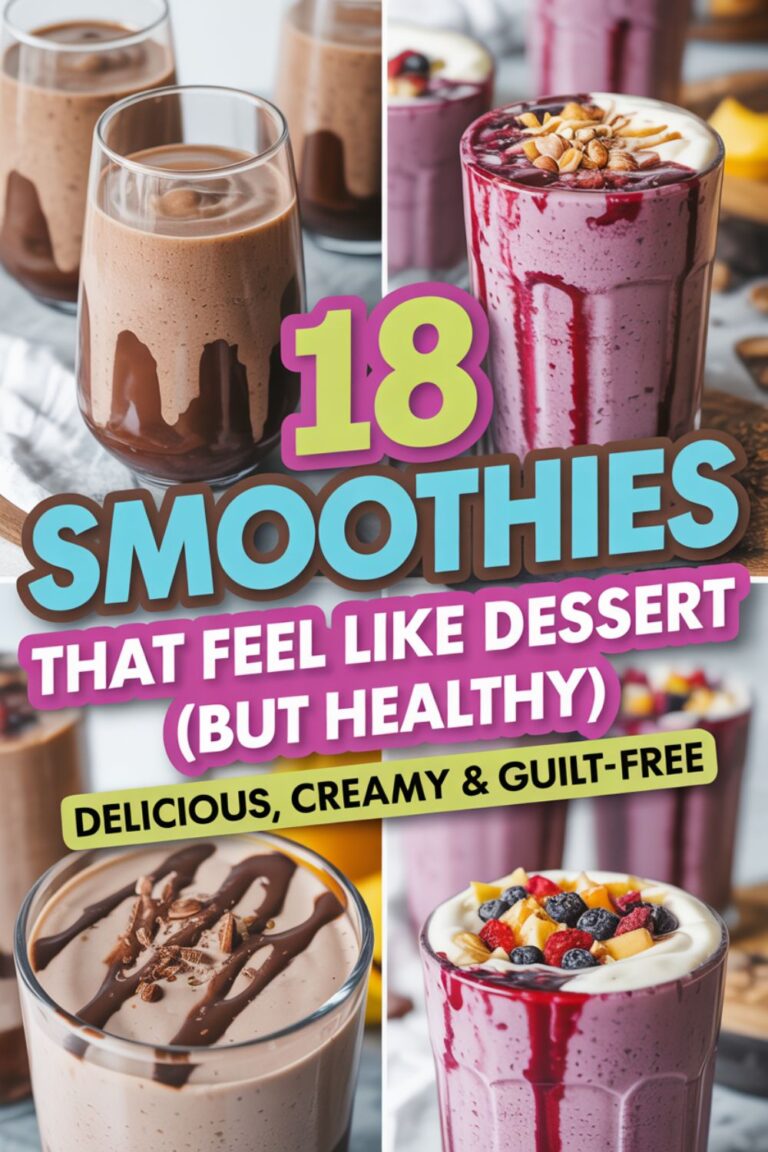
If the dessert-style angle is your thing, check out 18 smoothies that feel like dessert but healthy for a deeper dive. And for anyone who prefers smoothies thick enough to eat with a spoon, these 21 thick smoothies are exactly what that sounds like.
Freezer-Prep Smoothies for Busy Weeks
Here’s the honest truth about smoothie habits: they work when they’re easy, and they fall apart the moment they’re inconvenient. Prepping smoothie packs — frozen bags with everything measured and ready — turns a five-ingredient recipe into a 90-second morning routine. These last four are designed with that exact philosophy in mind.
Sunday Prep Green Power Pack
Everything goes in the bag except the liquid. Monday through Friday, you pull out a bag, dump it in the blender, add a cup of almond milk, and blend for 45 seconds. That’s the entire process.
- 2 cups spinach (freeze flat first)
- 1/2 cup frozen mango
- 1/2 frozen banana
- 1 tbsp chia seeds
- 1 tbsp hemp seeds
- Add 1 cup almond milk at blend time
Ginger Peach Immunity Smoothie Pack
Frozen ginger is a revelation — grating a knob of fresh ginger every morning is fine in theory and a nuisance in practice. Peel, slice, and freeze a full ginger root on prep day and you’ll have it ready for weeks.
- 1 cup frozen peach slices
- 1 thumb frozen ginger (approx. 1 tsp grated)
- 1 cup baby spinach
- 1 scoop vanilla protein powder
- Add 1 cup almond milk at blend time
Cocoa Banana Oat Freezer Pack
Rolled oats freeze without any issue and add creaminess and beta-glucan fiber to anything they touch. This one is the most meal-like smoothie in the list — filling, warm in flavor, and deeply satisfying.
- 1 frozen banana (sliced before freezing)
- 1/4 cup rolled oats
- 1 tbsp cacao powder
- 1 tbsp natural almond butter
- 1 scoop chocolate protein powder
- Add 1.25 cups oat milk at blend time
Blueberry Flax Chia Power Pack
This is the lowest-effort entry on the list and arguably the most nutritionally complete. Blueberries, two seed types, and Greek yogurt give you antioxidants, omega-3 fatty acids, soluble fiber, and a serious protein hit in a single glass.
- 1 cup frozen blueberries
- 1 tbsp chia seeds
- 1 tbsp ground flaxseed
- 3/4 cup plain Greek yogurt
- Add 1/2 cup almond milk at blend time
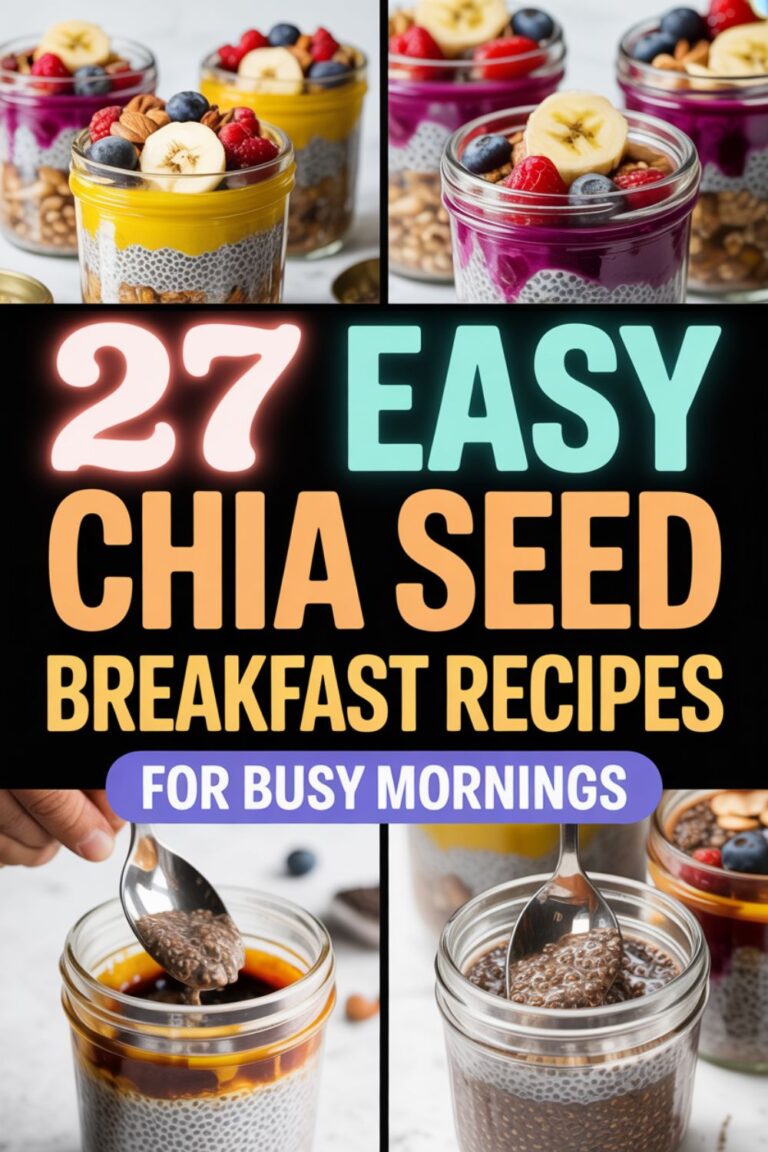
For the full freezer-pack system with prep-day instructions and storage guidance, the 25 smoothies you can prep and freeze article walks through the process in detail. It pairs well with the make-ahead breakfasts for the whole week guide if you want to extend the Sunday-prep mindset beyond just smoothies.
“The freezer pack system genuinely changed how consistent I am. I used to skip breakfast three or four days a week and wonder why I was so hungry by noon. Now I actually eat something every morning and I’ve noticed a real difference in how I feel and how my clothes fit.”
— James K., from the LovelyEase communityTools and Resources That Make This Easier
The actual things worth having in your kitchen and bookmarks for making smoothies work long-term.
Physical Products
-
Digital Kitchen Scale (1g precision) Measuring nut butter and seeds by eye is how smoothies go from 300 to 600 calories without you noticing. A small scale removes all the guesswork. I use mine for smoothie ingredients more than anything else in the kitchen.
-
Silicone Freezer Tray with Lid (for smoothie cubes) Blend a double batch, pour the extra into these trays, freeze, and drop three or four cubes into your next smoothie. Practically zero effort, zero waste.
-
Glass Meal Prep Containers (1L, set of 5) For storing pre-portioned smoothie ingredients in the fridge if you prefer prepping day-by-day rather than freezing. Airtight, stackable, and much better than re-used takeout containers.
Digital Resources
-
21-Day Flat Belly Reset Plan A complete three-week structure for meals around these smoothies. If you want a plan rather than just recipes, this is where to start.
-
7-Day Blood Sugar Balancing Meal Plan Pairs well with the low-sugar and high-protein smoothies in this list — controls the full day’s glycemic load, not just breakfast.
-
Complete Smoothie Nutrition Tracker (PDF Download) A printable or fillable PDF for tracking your daily smoothie macros without needing an app. Useful for the first couple of weeks until portion sizing becomes second nature.
Pro Tip
Add ingredients in blending order to extend your blender’s life: liquids first, then soft fruits and yogurt, then leafy greens, then frozen items and ice on top. This pulls everything toward the blade properly and stops the motor from straining on dry frozen chunks.
The Short Science on Smoothies and Weight Loss
Worth spending two paragraphs on this, because there’s a lot of well-intentioned noise in the smoothie-for-weight-loss space. Smoothies are not magic, and no combination of ingredients will melt body fat independently of a calorie deficit. What they do very well is make it easier to maintain that deficit without feeling deprived, which is IMO the most underrated part of any weight-loss approach.
Protein’s role in satiety is the best-documented mechanism. Research consistently shows that high-protein foods increase the release of satiety hormones like GLP-1 and PYY while suppressing ghrelin, the primary hunger hormone. Getting 25–30g of protein into breakfast through a smoothie is one of the most practical ways to reduce calorie intake at subsequent meals without conscious effort or willpower.
Fiber works through a different pathway. Soluble fiber — found in chia seeds, oats, flaxseed, and most berries — forms a gel-like substance in the digestive tract that slows gastric emptying and blunts postprandial blood glucose spikes. This means energy is released more gradually, hunger returns more slowly, and the cravings cycle that drives overeating is significantly dampened.
The takeaway: a smoothie that combines adequate protein and fiber in a controlled calorie range isn’t just a convenience — it’s a mechanically sound approach to managing hunger and energy. If you want to build on this further with structured hormone support, the 7-day hormone balancing meal plan applies many of the same nutritional principles across a full week of eating.
Frequently Asked Questions
How many smoothies per day is optimal for weight loss?
One smoothie per day replacing a full meal — typically breakfast — is the most sustainable and evidence-supported approach. Replacing two meals with smoothies is possible short-term, but tends to lead to nutritional gaps and diet fatigue. Your best results will come from pairing your daily smoothie with balanced whole-food meals for the rest of the day.
Can smoothies replace meals, or are they just snacks?
A smoothie absolutely can replace a meal — but only if it’s built to function as one. That means at least 20–25g of protein, at least 7–10g of fiber, healthy fats for sustained energy, and enough total calories to represent a genuine meal (350–500 calories for most adults). Most of the 25 recipes above meet this threshold. A smoothie with just fruit and juice does not.
Is peanut butter or almond butter better in a weight-loss smoothie?
Both are excellent additions. Peanut butter is slightly higher in protein and typically less expensive; almond butter is higher in vitamin E and magnesium. The calorie and fat content is similar between the two, so the choice genuinely comes down to preference and tolerance. What matters more is measuring — two tablespoons is the target, not two generous scoops.
Do I need protein powder to make weight-loss smoothies work?
No. Greek yogurt, cottage cheese, silken tofu, hemp seeds, and nut butters can all contribute meaningful protein without a scoop of powder. That said, protein powder is the most efficient way to hit 25g+ in a single smoothie, particularly for breakfast when whole-food protein sources require more volume. The 21 smoothies without protein powder collection proves the point if you’d rather avoid it entirely.
Are frozen fruits as nutritious as fresh in smoothies?
Yes, and in some cases more so. Frozen fruits are flash-frozen at peak ripeness, which locks in their nutrient content. Fresh fruit that’s been sitting in a grocery store for several days has often lost a meaningful percentage of its water-soluble vitamins. For smoothies specifically, frozen fruit is the better choice on both convenience and nutritional grounds.
The Bottom Line
Smoothies for weight loss work — not through any particular ingredient magic, but because a well-built smoothie makes it consistently easier to eat less, feel better, and avoid the mid-morning energy crash that drives poor food decisions. The 25 recipes here are your starting point, not a rigid prescription.
Pick two or three that genuinely appeal to you and make them your defaults. Build the freezer-pack habit. Measure your nut butter. And pair your morning smoothie with meals that support the same goals across the rest of the day. That’s the whole strategy, and it works better than any 21-day reset program precisely because it’s sustainable beyond day 21.
Start with Sunday prep, choose one smoothie for the week, and adjust from there. The habit builds faster than you’d expect.